





.jpg)





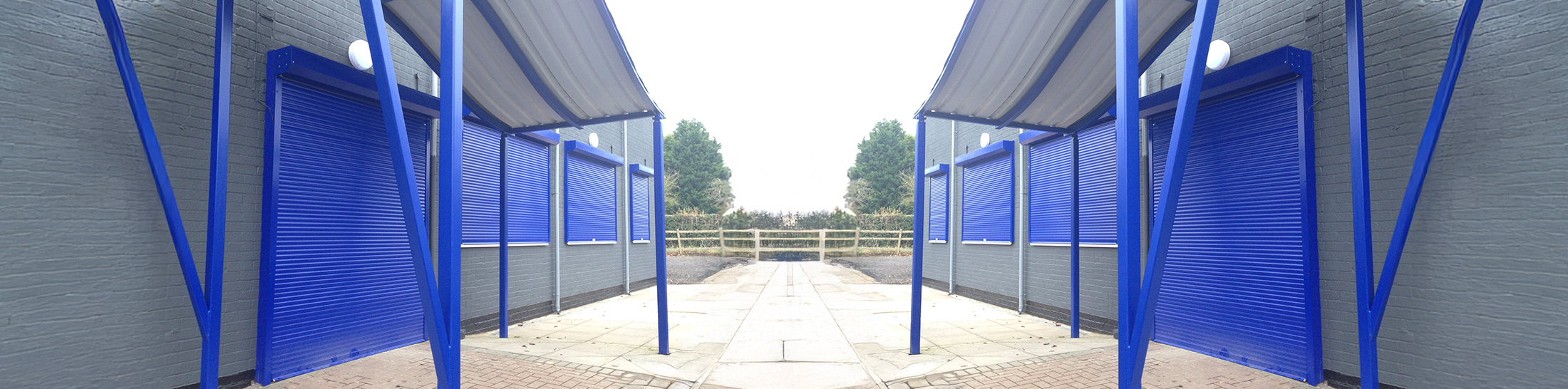
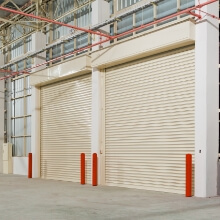
Electric Security Shutters
A Complete Guide to Control and Daily Operation
The Samson range of security shutters is extensive, offering solutions from low to high-level security with numerous options. You can choose from different slat sizes and shapes in steel or aluminium, tailored to your security needs.
While manual shutters are common, many wonder why electric operation is necessary. In reality, the cost difference is minimal - modern tubular motors are now often comparable in price to manual locking systems with spring balances and handles.
The real advantage of electric shutters is convenience, especially for external or hard-to-reach installations. Often, larger shutters require electric operation, which naturally leads to smaller shutters being automated for consistency. When multiple shutters are involved, electric operation saves time and ensures they’re closed properly, something that can be overlooked with manual systems.
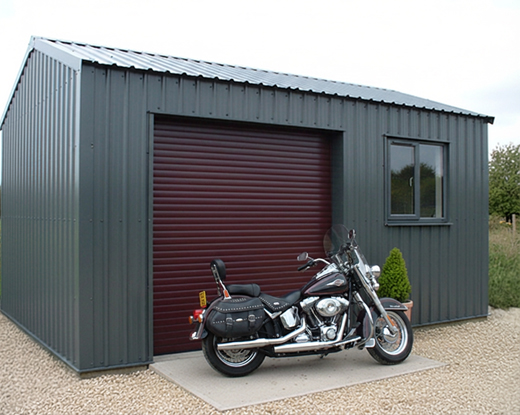
Understanding Electric Security Shutter Systems
A tubular motor installed inside the roller tube at the shutter's head powers an electric security shutter. This motor eliminates the need for manual operation by raising and lowering the curtain.
The motor connects to a control system. At its simplest, this may be a wall-mounted switch. More complex systems allow operation by remote control, smartphone app, automation hub or voice assistant.
The most often specified models for residential applications are the Model 150, Model 38 (3801 for security rated), and the Seceuroshield 60. While still offering strong security for windows, doors, and smaller apertures, these motors and shutter systems have a sleek design that complements home openings.
Higher-duty solutions are typically needed for commercial installations. In situations where robustness and long-term endurance are crucial, the Model 60 and Model 75 are made to withstand frequent daily use and bigger openings.
Get in Touch
Please contact us to discuss your specific requirements and discover how Electric Security Shutters can elevate the functionality and appearance of your premises.
Call us today on 01933 44 88 50
Email enquiries@samsondoors.co.uk or check out some of our more standard doors in our online shop.
Basic Control Methods:
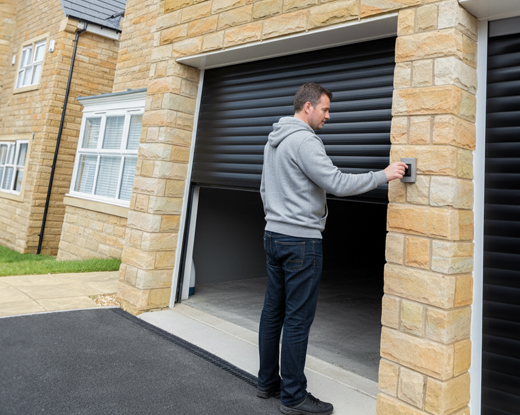
Wall-Mounted Push Button Controls
Push button controls remain one of the most reliable and widely used options. They are simple, durable and easy to operate.
Most units feature two buttons, one for opening and one for closing. Some include a third stop button to allow precise positioning.
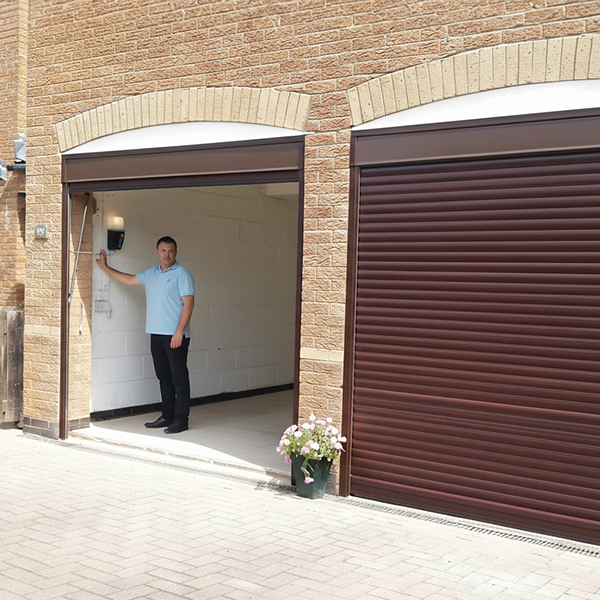
Push button controls operate in two modes:
Hold to Run (Maintained Operation): The operator must keep the button pressed while the shutter is moving. Releasing the button stops the shutter immediately. This offers a high level of safety, as the shutter only moves under direct supervision.
Impulse Operation: A single press sends the shutter fully open or fully closed. UK safety regulations require additional protection when impulse operation is used, such as a bottom rail safety edge.
Rocker Switch Controls
Although they use a toggle-style action, rocker switches serve the same purpose as push buttons. They provide a uniform appearance across fittings and are frequently used when shutters are put alongside lights or other building controls.
Key Switch Controls
For shutters requiring restricted access, key-operated switches provide an additional security layer. These are particularly valuable in commercial settings where only authorised personnel should operate shutters, or in domestic properties where child safety is paramount.
Obviously a key switch control is essential when the operation is from an external position and accessible by anyone. You can have surface mounted or flush key switches and often they are housed in a steel box with a padlock for further protection from vandalism. Any decent quality key switch will be protected against unlawful operation without the actual key used.
Wireless Remote Control Systems
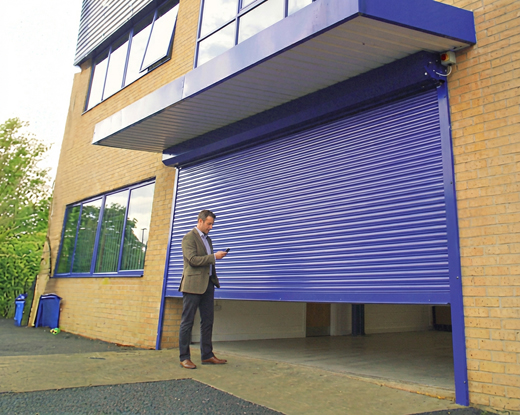
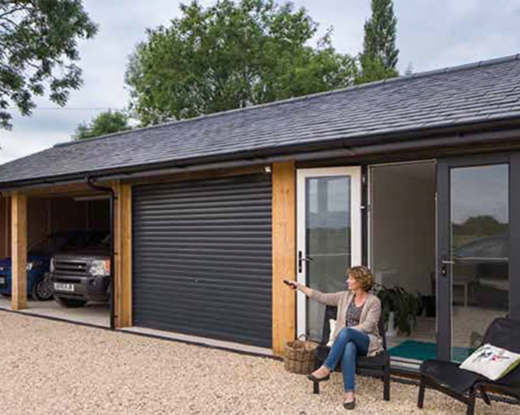
Remote control operation brings convenience and flexibility to security shutter management. A wireless handheld transmitter communicates with a receiver unit positioned adjacent to the shutter motor.
It is not usual to use remote control for any commercial applications, but often used for domestic security shutters and roller shutter garage doors.
Radio Technology Somfy (RTS)
RTS is a widely used wireless control system for shutters. Somfy’s radio frequency technology provides reliable communication over distances of up to 20 metres, and up to 65 feet in ideal conditions.
The signal does not require line of sight, meaning the remote does not need to be pointed at the shutter and can operate through walls.
RTS offers several practical advantages:
- Rolling code encryption with 16 million combinations to prevent unauthorised operation
- No additional control wiring required
- Multi-channel remotes capable of controlling up to four shutters independently
- Programmable favourite positions for light and privacy
- Remotes can be added or removed without rewirin
Single and Multi-Channel Remotes
Single-channel remotes operate one shutter or a group of shutters together. This suits shopfronts, loading bays or similar areas where shutters are intended to move at the same time.
Multi-channel remotes provide independent control of up to four shutters, with the option to group them where required. This is particularly useful in larger buildings or properties with multiple protected zones.
Smart Control and App Operation
Electric security shutters can be integrated into modern smart home or building systems, allowing control via smartphone apps and automation platforms.
Smartphone App Control
Smart control systems connect shutters to a WiFi network, enabling operation through dedicated mobile apps. Common platforms include Smart Life / Tuya, TaHoma, ALUTECH Smart and manufacturer-specific solutions.
App-based control allows:
- Operation from any location with an internet connection
- Real-time status feedback and movement alerts
- User access management for family members or staff
- Individual or grouped shutter control from one interface
Voice Control Integration
Shutter operation is now hands-free thanks to voice assistants. Systems that are compatible include:
- Amazon Alexa: "Alexa, close the shop shutters"
- Google Assistant: "Hey Google, open the bedroom shutters to 50%"
- Apple Siri: "Siri, close all the shutters"
A compatible smart home hub, like the Somfy TaHoma Switch, which connects RTS-enabled shutters with voice assistant platforms, is necessary for voice control.
Voice control requires integration through a compatible smart home hub such as the Somfy TaHoma Switch, which bridges RTS-enabled shutters with voice assistant platforms.
A high degree of obstacle detection would be required for any shutters over a certain size or weight with smart controls as they can be operated without being anywhere near the site.
Home Automation Hub Integration
Smart home hubs enable complex automation scenarios by centralizing control of several linked devices. With support for up to 200 io-homecontrol devices, up to 50 RTS devices, up to 50 Zigbee 3.0 devices, integration with over 280 equipment ranges from 21 major brands, and compatibility with Amazon Alexa, Google Assistant, and Apple HomeKit, the Somfy TaHoma Switch is the industry leader in security shutter integration.
Depending on the motor technology and receiver compatibility, alternative platforms like Samsung SmartThings, Apple HomeKit, and IFTTT provide different degrees of shutter control.
Features of Automation
In addition to increasing convenience, automation can boost energy efficiency and security.
Time-Based Scheduling Shutters can have distinct daily schedules that are configured to run at predetermined times.
Common applications consist of:
- Opening and closing in line with business hours
- Reduced operation at weekends
- Holiday modes that simulate occupancy with random movement
Dawn and Dush Control
Instead of fixed times, shutters can respond to actual sunrise and sunset. This provides consistent operation throughout the year and is particularly useful for security and seasonal energy management.
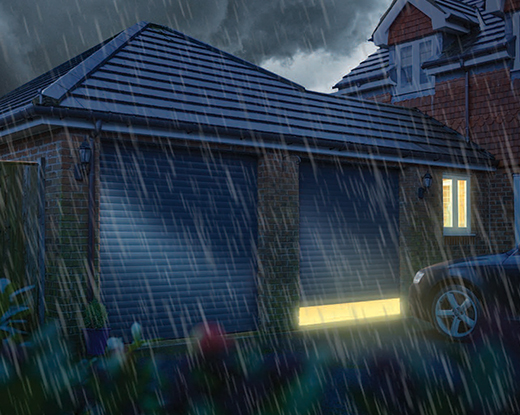
Weather-Responsive Control
Environmental sensors allow shutters to respond automatically to conditions:
- Sun sensors measure brightness levels, typically between 20,000 and 40,000 lux, and close shutters to reduce glare or heat gain
- Wind sensors monitor wind speed and raise shutters when preset limits are reached, usually between 30 and 99 km/h
- Rain sensors detect rainfall and adjust shutter position to reduce water ingress
- Temperature sensors trigger movement to help manage internal temperature
Location-Based Automation (Geofencing)
Geofencing uses smartphone GPS data to control shutters automatically:
- Shutters open as you approach the property, typically within a 100–500 metre radius
- Shutters close when all registered users leave the area
- Individual rules can be applied depending on who is present
Scene Control
Scenes combine multiple actions into a single command:
- “Good Morning” opens shutters and adjusts lighting and heating
- “Leaving Home” closes shutters and activates security systems
- “Entertaining” sets shutters to preset positions for privacy
- “Bedtime” closes all shutters and enables night security
Group Control Systems
Group control is useful where multiple shutters operate together:
- Synchronised operation allows up to eight shutters to be controlled from one device
- Zoned control divides larger installations into areas such as frontage, loading bays or perimeter security
- Where the operator cannot see every shutter, additional safety devices are required.
Safety and Compliance
UK regulations require specific safety measures for electrically operated shutters, particularly where remote or automated control is used.
Obstacle Detection
Bottom Rail Safety Edges
Safety Edges (Bottom Rail Protection): Pressure-sensitive strips fitted along the bottom edge of the shutter curtain detect obstructions during closing. Upon contact, the shutter immediately stops and reverses direction, preventing crushing injuries or property damage.
The use of these safety systems is mandatory in the UK once the weight of the shutter or the forces applied when closing get to a certain level and the shutter is controlled remotely, so therefore the operator cannot see whether any obstacles are present.
Two main safety edge technologies exist:
-
Optical edges: Use infrared light beams within a rubber profile. Compression breaks the beam, triggering the safety response.
-
Resistive edges: Employ conductive strips that short-circuit when the rubber housing compresses.
Photocells
Infrared beams fitted across the opening detect obstacles before contact occurs.
Inherent Force Limitation
Modern motors monitor resistance and stop automatically if unexpected force is detected.
Selecting the Right Control System
Selecting appropriate controls depends on several factors:
Domestic Installations
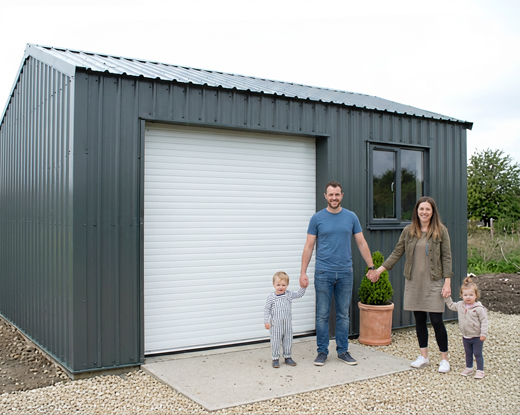
SeceuroShield 150, 38 or 60
- Wall switches or single-channel remotes for basic operation
- Multi-channel remotes for multiple shutters
- WiFi-enabled systems for app control and scheduling
- Full automation using TaHoma Switch with sensors and voice control
Commercial Installations
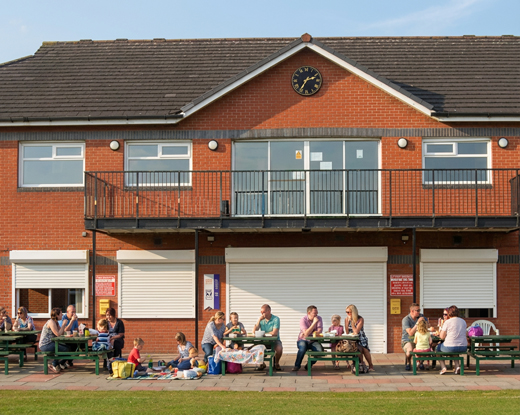
SeceuroShield 60 or 75
- Key-operated wall controls to restrict access
- Group control systems for multiple shutters
- Time-based automation linked to alarms or building systems
- Smart platforms for remote monitoring and integration
Installation Considerations
Wired and Wireless Controls
Wired Controls connect the switch directly to the motor and are best suited to new builds or major refurbishments.
Wireless Controls (RTS) systems remove the need for control wiring and are ideal for retrofits or listed buildings. Only a mains supply is required at the motor.
Power Supply
Electric shutters require a permanent mains connection. All electrical work must be completed by qualified electricians in accordance with UK Building Regulations Part P.
Smart receivers and control systems typically operate on low voltage, supplied either by the motor or a plug-in transformer.
Future-Proofing Your Installation
When specifying new shutters, it is sensible to allow for future automation:
- Choose motors compatible with RTS and smart control systems
- Install neutral wiring at switch positions
- Specify receivers with upgradable firmware
- Where possible, select open protocols such as Zigbee or Z-Wave
Specification Checklist
When considering or ordering electric security shutters for your domestic or commercial property, consider:
Control Options:
- Wall switch (hold-to-run or impulse)
- Single or multi-channel remote
- Smart WiFi app control
- Smart hub integration
- Voice control compatibility
Safety Features
- Bottom rail safety edge (mandatory for impulse/remote operation on shutters over a certain size)
- Photocell protection for additional protection in public places
- Inherent motor force limitation
- Emergency manual override for essential doors or windows
Automation
- Time scheduling
- Dawn and dusk control
- Weather sensor integration
- Geofencing
- Scene control
Integration Requirements
- Compatibility with existing smart home systems
- Voice assistant integration (Alexa/Google/Siri)
- Building management system interface
- Security system integration
Electric Security Shutter Range
Domestic Models
- Model 150 – protection for standard residential openings
- Model 38 / 3801 – compact option for windows and smaller doors
- Model 60 – suitable for domestic doors and lighter commercial use
Commercial Models
- Model 75 – heavy-duty solution for high-traffic premises
- Model 60 – commercial-grade performance with domestic compatibilit
Each model can be supplied with control options ranging from simple wall switches to full smart automation.
Our technical team can advise on the most appropriate control system for your property and usage requirements. For detailed technical guidance, specification support or automation advice, please contact us.