



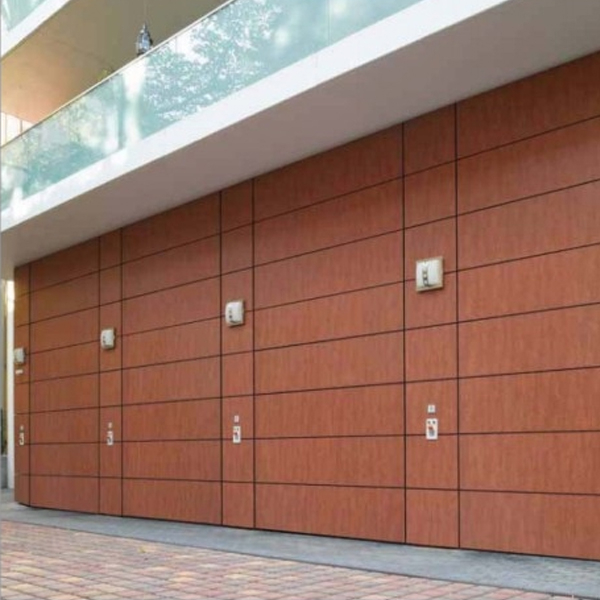
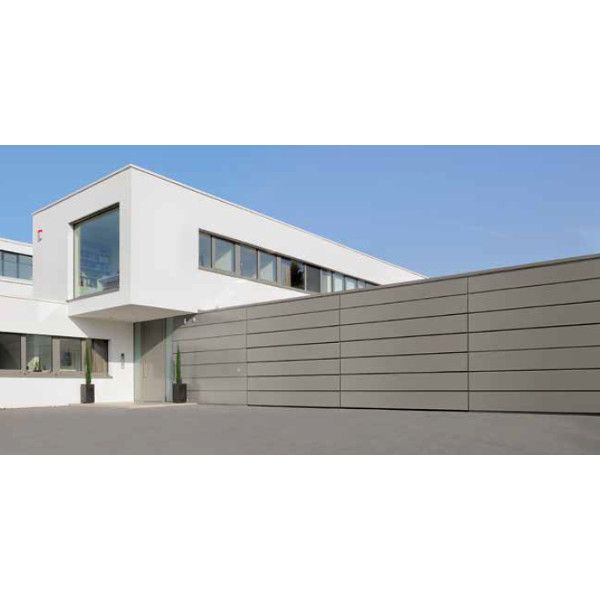
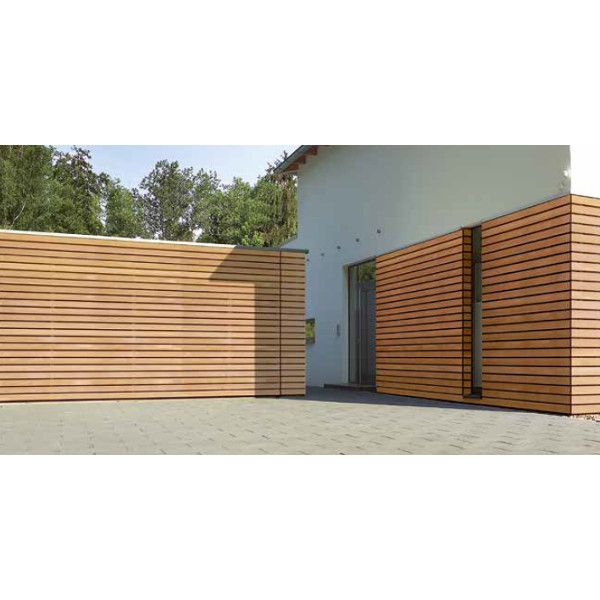

The Hormann ALR F42 is an aluminium industrial sectional door designed and ready for on-site cladding by others, with either timber, metal or many other suitable exterior building materials. The facade cladding door base consists of frame profiles with PU sandwich infill. The horizontal profiles are cladded.
You can design the on-site, flush fitting facade cladding according to your design with either timber, metal, ceramic or plastic.
Please Note: There is a maximum weight per door unit depending on size and mechanism specification, please ask for further details.
Many modern buildings require bespoke door designs and require doors which blend in completely with their facade. This door is perfect for just such applications, offering all the benefits of a sectional door mechanism and the vertical movement for minimal disruption at ground level insude and outside the entrance. Manual or electric operation with a whole range of access controls for the perfect management and security of the door.



- Description
- Application
- Specification
- Installation
Hörmann ALR F42 “Create Your Own Design” (On-Site Cladding)
Make the Door Blend Into the Façade
If you need an industrial sectional door that doesn’t look like an industrial door, the Hörmann ALR F42 “Create Your Own Design” is built for exactly that. It is supplied as an aluminium framework door designed to be clad on-site, allowing the finished face to match the rest of the building rather than standing out.
This approach works especially well on high-end commercial units, showrooms, and architectural projects where the elevation is the priority, but you still need a reliable, hard-working sectional door behind the scenes.
Framework Ready for Your Chosen Finish
The door is essentially a strong aluminium framework with an infill, prepared so your chosen façade material can be fixed to it. Depending on the design, that could be timber boards, metal sheets/panels, ceramics, composites, or other sheet materials, giving you a far wider design choice than a standard factory finish.
Because the cladding is specified separately, it is much easier to match surrounding materials, colours, and textures. Done well, the door can visually “disappear” into the façade lines.
Designed with Real-World Installation in Mind
Cladding a sectional door needs careful planning, mainly around weight, fixing methods, and how the door moves through its travel. The ALR F42 is engineered to take the additional load, but the final specification should always consider weight per square metre, wind exposure, and how the cladding will be weathered and sealed at the edges.
For best results, treat this as an engineered join between door and façade rather than a decorative add-on. The end goal is a door that looks sharp and remains smooth and dependable in daily use.
Typical Uses
This door style is often chosen for:
- Prestige vehicle showrooms and dealerships
- Corporate buildings where branding and appearance matter
- Sensitive or heritage-style elevations where the door should not dominate
- Mixed-use developments where industrial access needs to sit comfortably alongside residential or retail design
- Commercial units where a premium façade finish is part of the project brief
Size and Performance Notes
The ALR F42 is suitable for larger industrial openings and can be specified for substantial widths and heights, depending on the final cladding weight and overall build-up. Insulation is provided via the door construction, and the cladding specification can influence the overall thermal feel of the building envelope (particularly if you choose insulated or timber-based finishes).
Because the final door weight is affected by the chosen façade material, the spring balance and operator choice should be selected to suit the finished door, not just the base door.
Specification Snapshot
- Door Type: Aluminium framework sectional door for on-site cladding
- Framework Depth: 42 mm
- Cladding: Site-applied finish, typically sheet or panel materials (project dependent)
- Max Opening Size: Available for large industrial openings (final limits depend on cladding weight and configuration)
- Best For: Architectural façades where a standard industrial door finish isn’t suitable
The primary advantage of the ALR F42 facade door is its ability to hide in plain sight. By accepting on-site cladding, it bridges the gap between architectural vision and industrial necessity. It is most frequently specified in sectors where visual continuity is as important as operational reliability.
Vehicle Dealerships and Showrooms
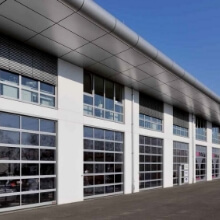
Modern car dealerships often require wide access points for moving vehicles into the showroom, yet standard industrial shutters can look out of place against high-spec glazing and clean lines. The ALR F42 allows the access door to be clad in the same materials as the showroom façade—whether that is aluminium composite, high-gloss panels, or extensive glazing—maintaining the brand experience even when the door is closed.
Heritage and Conservation Areas
Planning restrictions in conservation areas often rule out standard roller shutters or ribbed sectional doors due to their modern, utilitarian appearance. This system offers a workaround: the door face can be clad in timber, vertical boarding, or specialist materials that mimic the surrounding stonework or traditional barn aesthetics. This allows building owners to satisfy planning officers and maintain the character of the area without sacrificing the security and thermal benefits of a modern industrial door.
High-End Residential and Private Collections
For luxury residential properties or private car collections requiring industrial-scale openings (over 5m wide), standard garage doors are often too small, and industrial doors look too aggressive. The door functions as a "super-sized" residential door, capable of carrying heavy timber or zinc cladding to match the main house. It creates a seamless flush finish that standard domestic doors cannot achieve.
Mixed-Use Urban Developments
In city centres where retail, residential, and logistics spaces share the same footprint, loading bays are often visible from the street. An ALR F42 clad in the building’s external material (such as rainscreen cladding or ceramic panels) effectively disguises the loading dock when not in use, preventing the "back of house" service areas from lowering the tone of the residential or retail frontage.
Shopping Centres and Public Buildings
Museums, galleries, and high-end shopping centres use these doors to mask large service entrances that face public walkways. By continuing the wall finish across the door surface, the opening becomes indistinguishable from the rest of the wall, preserving the architectural flow of the building.
| Performance Characteristics According to EN 13241-1 | |||||
|---|---|---|---|---|---|
| Construction and quality features | ALR F42 | ALR F42 Thermo |
ALR 67 Thermo |
ALR 67 Thermo Glazing |
|
| Resistance to wind load EN 12424 | Door without wicket door, class | 3 6) | 3 6) | – | – |
| Door with wicket door, LZ ≤ 4000, class | 3 6) | 3 6) | 3 6) | – | |
| Door with wicket door, LZ > 4000, class | 2 7) | 2 7) | 2 7) | – | |
| Door with wicket door, LZ ≤ 8000, class | – | – | 3 6) | 3 5,6) | |
| Door with wicket door, LZ > 8000, class | – | – | 2 7) | – | |
| Water tightness EN 12425 | Door without wicket door, class | 3 (70 Pa) | 3 (70 Pa) | 3 (70 Pa) | 3 (70 Pa) |
| Air permeability EN 12426 | Door without wicket door, class | 2 8) | 2 8) | 2 8) | 2 8) |
| Door with wicket door, class | 1 9) | 1 9) | 1 9) | 1 9) | |
| Acoustic insulation EN 717-1 | Door without wicket door Rw = . . . dB | 23 (301)) | 23 (301)) | 23 (301)) | 301) |
| Door with wicket door Rw = . . . dB | 22 | 22 | 22 | – | |
| Thermal insulation value EN 13241-1, appendix B EN 12428 |
Door without wicket door, U = W/(m2·K) 2) | 3.6 (3.6 4)) | 3.0 (3.0 4)) | 2.2 (2.1 4)) | – |
| – Optional triple glazing, U = W/(m2·K) 2) | 3.2 (3.1 4)) | 2.6 (2.5 4)) | – | – | |
| – Optional quadruple glazing, U = W/(m2·K) 2) | – | – | 1.9 (1.8 4)) | – | |
| – Optional climatic double panes (made of single-pane safety glass) U = W/(m2·K) 2) | 2.7 (2.6 4)) | 2.1 (2.0 4)) | 1.7 (1.6 4)) | 1.8 (1.7 4)) | |
| – Optional double panes (made of single-pane safety glass) U = W/(m2·K) 2) | 3.6 (3.6 4)) | 3.0 (3.0 4)) | 2.7 (2.6 4)) | 3.0 (2.9 4)) | |
| Door with wicket door, U = W/(m2·K) 2) | 3.8 (3.8 4)) | 3.2 (3.2 4)) | 2.4 (2.3 4)) | – | |
| – Optional triple glazing, U = W/(m2·K) 2) | 3.4 (3.4 4)) | 2.8 (2.8 4)) | – | – | |
| – Optional quadruple glazing, U = W/(m2·K) 2) | – | – | 2.1 (2.1 4)) | – | |
| – Section, U = W/(m2·K) | – | – | – | – | |
| Design | Self-supporting | ● | ● | ● | ● |
| Depth, mm | 42 | 42 | 67 | 67 | |
| Door sizes | Max. width mm, LZ | 8000 | 7000 | 10000 | 5500 |
| Max. height mm, RM 3) | 7500 | 7500 | 7500 | 4000 | |
| Material, door leaf | Steel, double-skinned, 42 mm | – | – | – | – |
| Steel, double-skinned, 67 mm | – | – | – | – | |
| Aluminium, standard profile | ● | – | – | – | |
| Aluminium, profile with thermal break | – | ● | ● | ● | |
| Surface, door leaf | Galvanized steel, coated RAL 9002 | – | – | – | – |
| Galvanized steel, coated RAL 9006 | – | – | – | – | |
| Galvanized steel, coated RAL to choose | – | – | – | – | |
| Anodised aluminium E6 / C0 (previously E6 / EV 1) | ● | ● | ● | ● | |
| Aluminium coated in RAL to choose | ○ | ○ | ○ | ○ | |
| Wicket door | ○ | ○ | ○ | – | |
| Side Door | Matching the door | ○ | ○ | ○ | ○ |
| Glazings | Type A section window | – | – | – | – |
| Type D section window | – | – | – | – | |
| Type E section windows | – | – | – | – | |
| Aluminium glazing frame | ● | ● | ● | ● | |
| Seals | All-round on 4 sides | ● | ● | ● | ● |
| Intermediate seal between the door sections | ● | ● | ● | ● | |
| ThermoFrame | PVC hard / soft seal | ○ | ○ | ○ | ○ |
| Locking systems | Internal latches | ● | ● | ● | ● |
| Outside / inside locking | ○ | ○ | ○ | – | |
| Anti-lift kit | For doors of up to 5 m with shaft operator | ● | ● | ● | ● |
| Safety equipment | Finger trap protection | ● | ● | – | – |
| Side trap guards | ● | ● | ● | ● | |
| Spring break safeguard for manual operation | ● | ● | ● | ● | |
| Safety catch for doors with shaft operator | ● | ● | ● | ● | |
| ● = Standard | * With glazing VG, E2 and G2 | |
| ○ = Optional | ** Top door section | |
| 1) With optional double pane (single-pane safety glass) | 4) Optionally with Thermoframe | 7) Class 2 = 0.45 kN/ m2 or 96 km/h |
| 2) For a door surface of 5000 × 5000 mm | 5) Door width up to 5500 mm | 8) Class 2 = 12 m3/m2h |
| 3) Door height above 7000 mm on request (not with door type ALR F42 Glazing) |
6) Class 3 = 0.7 kN/ m2 or 120 km/h | 9) Class 1 = 24 m3/m2h |
Installation and Cladding Guidelines
Installing a Hörmann ALR F42 "Create Your Own Design" door differs significantly from a standard industrial door installation. It requires collaboration between the door installer and the façade contractor. The process involves two distinct phases: the mechanical installation of the door framework and the application of the architectural cladding.
1. Critical Pre-Installation Planning
Before any physical work begins, the total weight of the proposed cladding must be calculated precisely. The door’s torsion spring mechanism is factory-manufactured to lift a specific load. If the cladding weight exceeds the specification provided at the ordering stage, the door will be too heavy to open manually and may burn out electric motors.
- Calculate Weight per m²: Ensure the cladding material (including fixings and adhesives) does not exceed the maximum fill weight allowed for the door size.
- Panel Thickness: Check that the cladding thickness allows for the required clearance at the lintel and side guides.
- Layering: If using timber, account for moisture absorption which can increase weight over time.
2. Option A: Cladding On-Site (Recommended)
The vast majority of projects follow this route. It offers the highest accuracy for aligning the door pattern with the surrounding building façade.
The Process:
- Step 1: The bare aluminium framework and glazing elements are installed into the opening first. The door is mechanically commissioned to ensure it runs smooth and true.
- Step 2: The door is closed and locked in the down position.
- Step 3: The façade contractor applies the cladding directly to the door panels while they are in situ. This allows for laser-alignment of horizontal lines (such as timber slatting or mortar lines) to match the adjacent walls perfectly.
- Step 4: The springs are tensioned after the cladding is applied to balance the new weight.
Pros: Perfect visual alignment; no risk of damaging finish during transport; easier manual handling of the raw panels.
3. Option B: Workshop Cladding (Pre-Installation)
Cladding the panels in a workshop environment before they are brought to site is possible but presents significant logistical challenges.
The Process: Panels are laid flat in a clean workshop, and the cladding is applied before the door is assembled. The fully finished panels are then transported to the site.
Risks to Consider:
- Manual Handling: A standard door panel might weigh 20kg, but a clad panel could weigh 60kg+. Lifting these into overhead tracks requires mechanical aids or extra labour.
- Transport Damage: Finished architectural surfaces are easily scratched or chipped during transit and offloading.
- Alignment Issues: If the floor level on site is slightly off, pre-clad horizontal lines may not match the building lines perfectly, with no room for adjustment.
4. Technical Fixing Details
Whether clad on-site or in a workshop, specific engineering rules apply to the fixing method to ensure the door operates safely.
- Section Gaps: You cannot bridge the gap between door sections. The cladding must be cut at each panel joint to allow the door to articulate as it rolls around the curve of the tracks. A consistent "shadow gap" is required between each panel.
- Fixing Points: Fixings (screws, rivets, or bonding agents) must be applied to the structural aluminium profiles, not the thin infill sheet. Care must be taken not to bridge the thermal break if insulated profiles are used.
- Weather Seals: The standard bottom rubber seal and side seals may need to be adjusted or packed out depending on how far the cladding projects from the face of the door.
5. Final Commissioning
Once the cladding is fully applied, the door MUST be re-balanced. The installer will adjust the tension on the torsion springs so that the door can be lifted manually with minimal effort. If the springs are not adjusted to the final weight, the door may drop suddenly (dangerous) or be impossible to lift (useless).