






.jpg)




What is a sectional door?
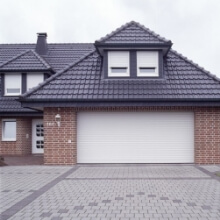
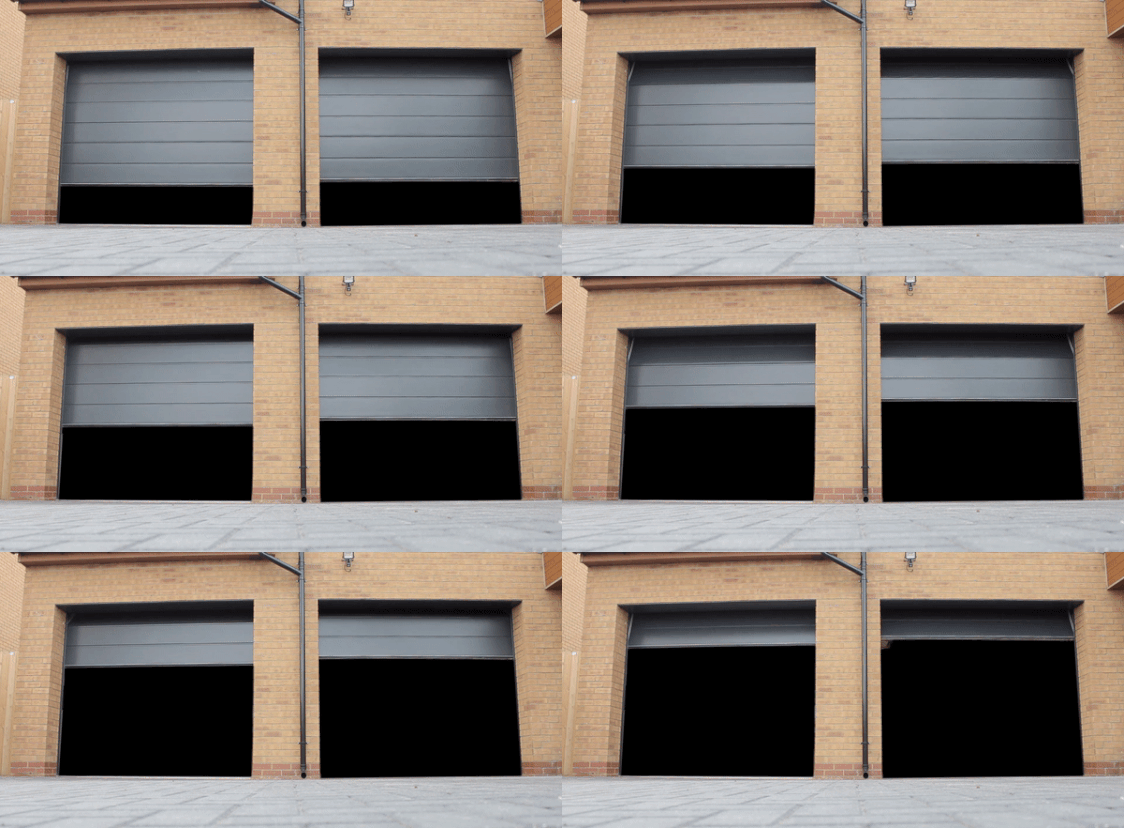
A sectional door (often called a sectional overhead door) is made from several wide horizontal panels that are hinged together and guided on tracks at each side of the opening. When it opens, it lifts vertically and then parks overhead (or travels up the wall), so there's no outward swing into a driveway, yard, or loading area.
In the UK you'll see sectional doors used in both domestic garages and commercial/industrial buildings—the concept is the same, but the specification changes (panel thickness, hardware duty level, glazing, automation, and the lift/track arrangement).



How sectional doors work
A sectional door opens in a controlled path because the panels run on rollers inside a track system. Springs counterbalance the door weight, which is why large doors can still feel smooth and "light" in operation, and why automation tends to be quiet and consistent.
Because the door is supported and guided throughout its travel, it doesn't rely on a flexible curtain wrapping tightly around a barrel. That's a big part of why good sectional doors feel solid, stay aligned, and perform reliably over long periods.

Why sectional doors perform so well
Because the door leaf is a set of insulated panels with continuous perimeter seals, a good sectional door can act as a genuine part of the building envelope, not a weak point in the wall.
Modern insulated steel sectional doors typically offer:
- Tested U-values for the entire door assembly (not just the panel core), making compliance and energy assessments straightforward
- Panel thicknesses from around 40 mm (domestic garage doors) up to 67–80 mm (high-performance industrial doors)
- Strong airtightness and weather sealing, reducing uncontrolled heat loss and draughts
As an example, a high-specification industrial sectional door such as the Hörmann SPU 67 Thermo can achieve a U-value of around 0.51 W/(m²·K) on a large door - performance that comfortably exceeds what most people expect from a "door" and shows how a well-designed sectional system can contribute positively to a building's thermal strategy.
For attached garages, workshops and heated or cooled commercial spaces, this translates into lower running costs, better comfort and easier compliance with current UK Building Regulations.
.jpg)
Panel construction and duty ratings
The core construction is similar across domestic and industrial sectional doors—steel skins with an insulating foam core—but the specification varies significantly:
- Domestic garage doors typically use 40–42 mm thick insulated steel panels, balanced for everyday home use with good thermal performance and moderate cycle life.
- Commercial and industrial doors step up to 42 mm as standard, with heavier-duty options at 60 mm, 67 mm and even 80 mm for high-performance or extreme-duty applications.
.jpg) |
 |
 |
 |
Thicker panels deliver better insulation, higher cycle ratings, improved wind and impact resistance, and a more robust feel in demanding environments. The beauty of the sectional door concept is that the same basic engineering principle scales cleanly from a single domestic garage right through to large industrial loading bays—you're changing duty level and specification, not switching to a completely different product type.
Sectional vs roller shutters (why drawings get it wrong)
A lot of confusion comes from the language used on drawings. "Roller shutter" is often written as a generic label, even when the sketch shows a door that runs on side tracks and parks overhead.
The practical difference is the door leaf:
- A sectional door is a rigid set of large insulated panels.
- A roller shutter is a curtain of narrow slats that coils into a box above the opening.
That difference affects what you can realistically expect from insulation, sealing, appearance, and day-to-day feel. If the goal is a door that behaves more like part of the building envelope (rather than a security curtain), sectional is usually the correct concept

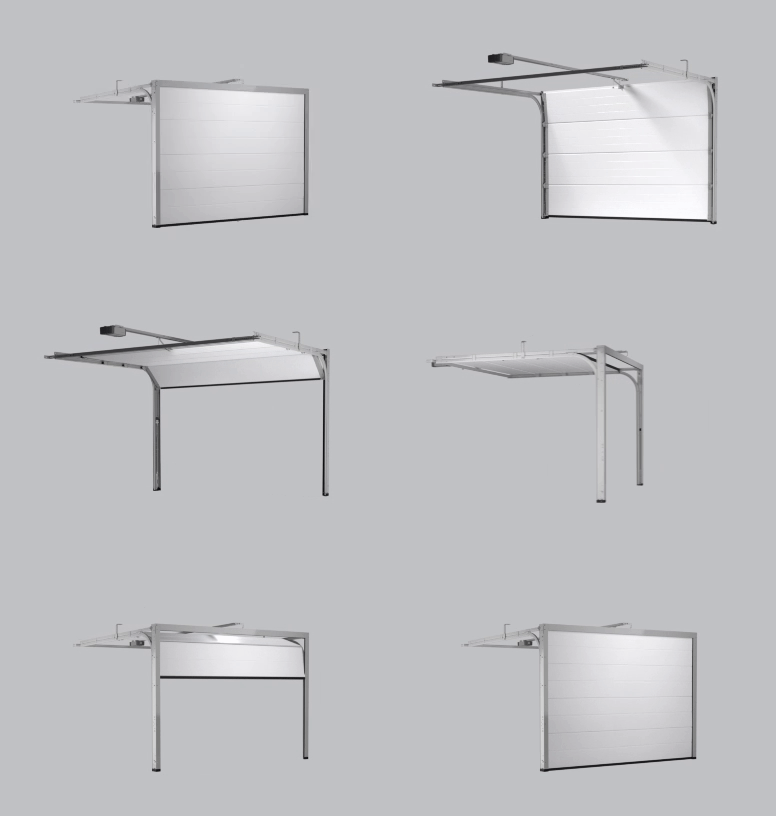
Tracks, headroom and lift types (the part most people worry about)
People often fixate on "the tracks", assuming they'll steal headroom or clash with lights, ductwork, racking, or a sloping ceiling. In reality, the track layout is one of the biggest advantages of a sectional door because it can be specified to suit the building.
Common lift options include:
- Standard lift – the door rises and turns back just above the opening, following a horizontal ceiling.
- High lift – the door travels higher up the wall before turning, keeping tracks above working height for vehicles, machinery or tall storage.
- Vertical lift – the door rises straight up the wall, ideal where you have plenty of height and want to keep the ceiling area completely clear.
- Low headroom – specialist track configurations for tight spaces where conventional lifts won't fit.
- Follow-the-roof – tracks follow the pitch of a sloping roof or ceiling, so the parked door aligns with the building structure.
The key point is simple: the door travel can be designed to maximise internal clearances (vehicles, storage, services), rather than forcing you into one fixed movement path.
Tracking system options
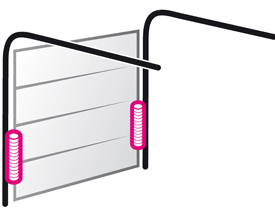 Z Track Sectional Frame |
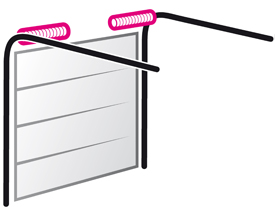 N Track Sectional Frame |
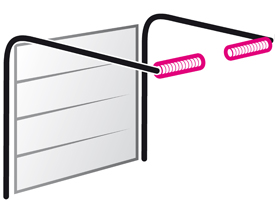 L Track Sectional Frame |
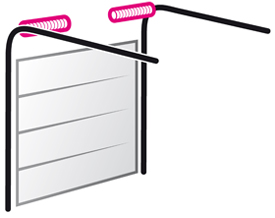 H Track Sectional Frame |
Automation and speed options
Sectional doors are well suited to automation because the guided, balanced mechanism makes operation smooth and predictable. For domestic use, modern electric operators are quiet, reliable, and can be integrated with remote controls, keypads or smart home systems.
In commercial and industrial environments, sectional doors can be specified with higher-duty operators and, where needed, high-speed variants designed for rapid open/close cycles. High-speed sectional doors are used in logistics, manufacturing and temperature-controlled facilities where minimising open time is critical for productivity, energy efficiency or contamination control.
Whether manual, standard electric or high-speed automated, the sectional door concept handles it all within the same basic framework.
.jpg)
Options that add real value
Insulation matters, especially as expectations around thermal performance and airtightness keep rising, but a sectional door's value isn't just "it's insulated".
A well-specified insulated steel sectional door can also offer:
- Strong security from a rigid, multi-layer door leaf and robust hardware.
- Smooth, quiet operation because the door is guided on rollers and tracks.
- Longevity because the panels are hinged and guided rather than being a curtain repeatedly coiling tightly on itself.
- A wide durability range, from typical domestic-grade panels through to thicker, heavier-duty commercial options; high-speed variants are also available where rapid cycles are important.
Glazing and vision panels
You can add simple top-row windows for daylight, step up to larger vision sections for better internal visibility, or choose full-vision style configurations where the opening needs to look modern and bring in lots of light.
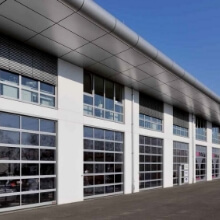
Full-vision sectional doors use large-format glazed panels in thermally broken aluminium frames, creating an almost entirely glazed façade that still opens vertically like a conventional sectional door. They're ideal for showrooms, car dealerships, workshops, fire stations, retail-fronted units and modern residential garages where architecture and natural light are as important as performance.

Built-in pedestrian doors (wicket doors)
A pedestrian door (wicket door) built into the main door leaf gives walk-through access without opening the full door. It's a big improvement for day-to-day use:
- Faster access – staff, visitors or family members can walk in and out without cycling the main door.
- Energy saving – in heated or cooled spaces, you avoid dumping conditioned air every time someone needs to enter or exit.
- Reduced wear – fewer full door cycles means less wear on the operator, springs, and moving parts.
- Safety and security – the pedestrian door can be equipped with appropriate locking, access control, and can be designed to open outwards with a low threshold to reduce trip risk.
In many commercial and industrial applications, a built-in pedestrian door removes the need for a separate side door, which can simplify layouts and save wall space. In domestic settings, it turns the garage into a much more usable space for bikes, tools and hobbies without constantly operating the main door.

Why sectional doors are the best value for money
When you compare total cost over the life of the door—not just the purchase price—insulated steel sectional doors consistently offer the strongest return across both domestic and commercial applications.
Key reasons include:
Lower wear and longer service life
The guided, balanced mechanism spreads loads evenly and avoids the harsh friction and flexing of curtain-based systems. In practice, this means less visible wear, fewer adjustments, and longer intervals before major components need replacing. A well-maintained sectional door can deliver decades of reliable service.
Energy savings
Better insulation and sealing reduce heat loss, which matters in attached garages, workshops and any conditioned space. Over time, the energy savings from a properly insulated sectional door can offset a significant portion of the initial investment, especially with rising energy costs and tighter Building Regulations expectations.
Dual-purpose performance
You get security, weather protection and insulation in one product, rather than needing separate solutions. A good sectional door does the job of both a thermal barrier and a physical security barrier, which simplifies specification and reduces overall project cost.
Scalability and flexibility
The same door concept works from a single domestic garage up to large industrial loading bays. You're specifying duty level, panel thickness, lift type, glazing and automation options—not switching to a completely different product family. That consistency makes sectional doors easier to specify, quote, install and maintain across a wide range of projects.
Proven performance
Because sectional doors have been widely used in both domestic and industrial settings for many years, there's a strong track record of performance data, cycle life testing, and real-world reliability. You're not specifying an experimental system; you're choosing a mature, well-understood technology with established supply chains and support.
For most mid-size openings where you want a door that works hard, lasts, keeps heat in, and remains reliable year after year, an insulated sectional overhead door is very hard to beat on real-world value

Common myths (quick fixes)
Myth: "Sectional doors always reduce headroom."
Reality: Headroom depends on the lift type and the building constraints; track layouts can be chosen to keep clearance where you need it. Low headroom options exist specifically for tight spaces. Most sectional doors have zero headroom reductions when opened.
Myth: "They're only for warehouses."
Reality: The same principle works brilliantly on domestic garages—especially where you want insulation, better sealing, and no swing-out. Sectional doors are now one of the most popular choices for UK home garages.
Myth: "They're basically the same as roller shutters."
Reality: The construction is different (rigid insulated panels vs narrow slats), which changes insulation potential, sealing, appearance, and how the door behaves over time. A roller shutter door can never achieve the same performance on insulation.
Myth: "The tracks will always be in the way."
Reality: Standard, high lift, vertical lift, low headroom and follow-the-roof track options exist specifically to work around real buildings, not perfect drawings. The track layout is specified to suit your space.
Myth: "Sectional doors are expensive."
Reality: Initial cost can be higher than some basic alternatives, but when you factor in energy savings, longer service life, lower maintenance and dual security/insulation benefits, sectional doors typically offer the best total cost of ownership.

Ready to specify or buy a sectional door?
Whether you're looking for an insulated garage door for your home or a commercial sectional door for a warehouse, workshop or loading bay, Samson Doors can help you choose the right specification, track layout and automation to suit your building and budget.