DescriptionMaximum Natural Light for Industrial Facilities
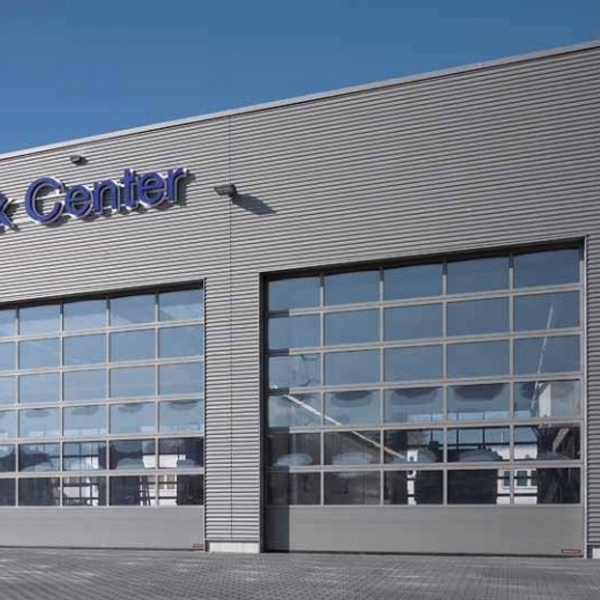
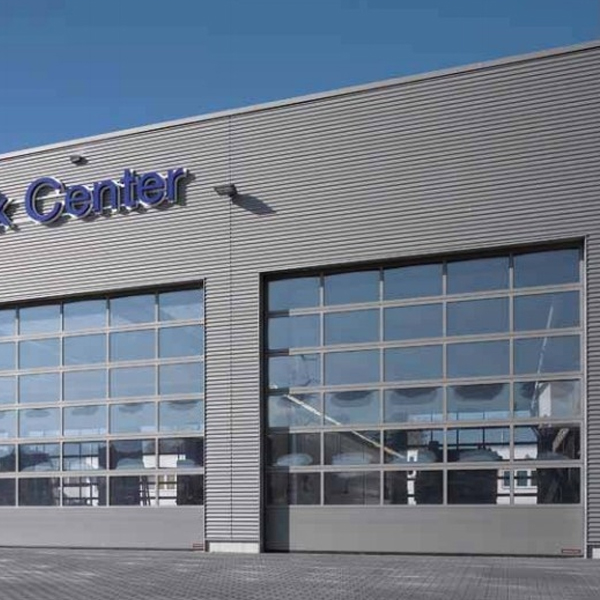
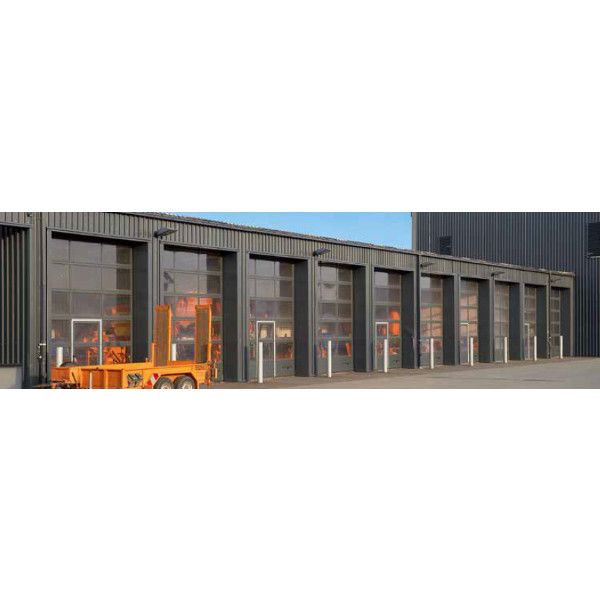
The Hormann APU F42 Vision represents the perfect solution for industrial premises requiring extensive natural light penetration whilst maintaining robust structural performance. This sectional door combines aluminium glazing sections with an insulated steel bottom panel, creating an optimal balance between visibility, thermal efficiency, and durability for commercial and industrial applications.
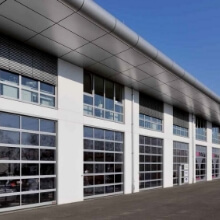
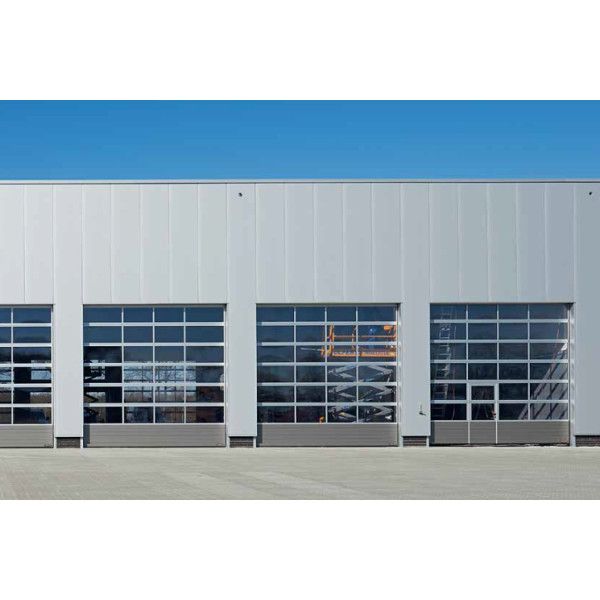
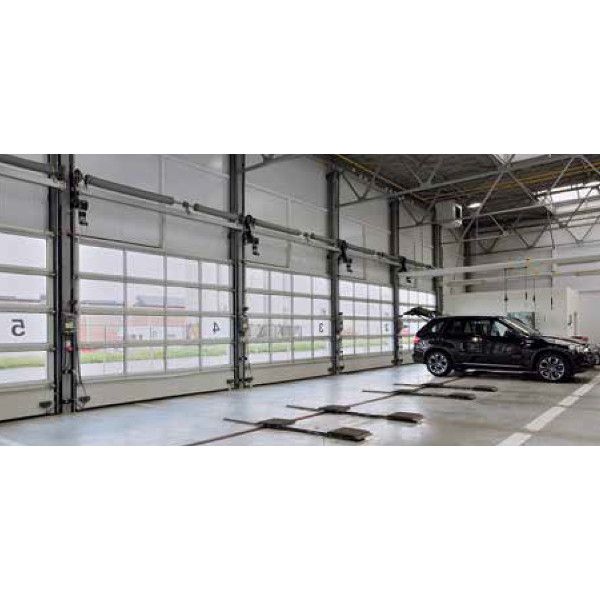
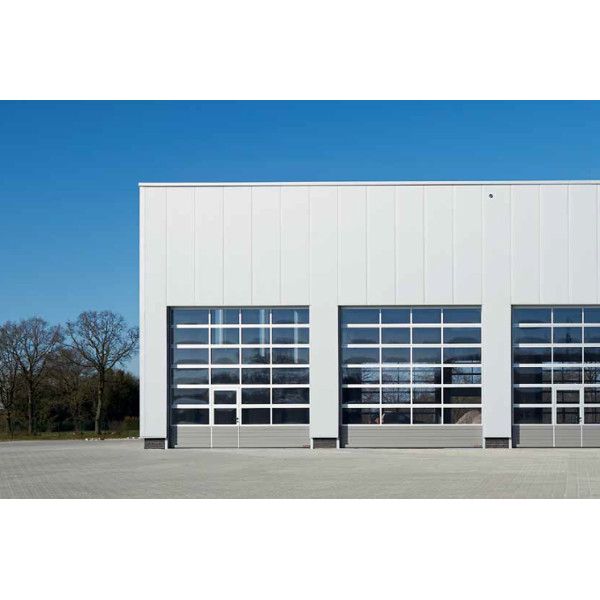
Featuring extensive aluminium-framed glazing panels across the majority of the door height, the APU F42 Vision delivers exceptional daylight transmission into warehouses, logistics facilities, vehicle showrooms, and manufacturing spaces. The transparent sections utilise real glass panels mounted in Series 60 aluminium extrusions, providing uniformly divided fields that create an architecturally refined appearance whilst flooding interior spaces with natural light.
Advanced Hybrid Construction System
The APU F42 Vision employs a sophisticated hybrid construction approach. The upper sections feature 42mm-deep aluminium profiles with extensive glazing, whilst the robust bottom section utilises double-skinned, PU-foamed steel construction. This steel base section provides essential impact resistance and dirt protection in the critical lower zone, where door panels face the greatest wear from forklift operations and vehicle movements.
The 42mm section depth offers self-supporting stability whilst maintaining relatively lightweight construction, enabling smooth operation with standard sectional door operators. Maximum dimensions accommodate 7000mm width and 7500mm height, suitable for large-format industrial openings.
Robust Performance Characteristics
Manufactured to Hormann's exacting industrial standards, the APU F42 Vision achieves Class 3 wind load resistance (up to 120 km/h), ensuring stable operation in exposed locations. Class 3 watertightness performance provides effective weather protection, whilst Class 2 air permeability minimises unwanted air infiltration.
Wicket Door Integration
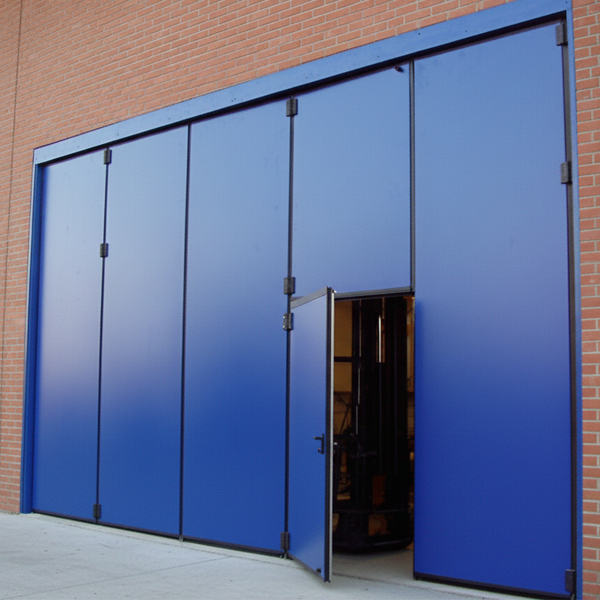
For facilities requiring convenient pedestrian access, the APU F42 Vision can incorporate an integrated wicket door with 940mm clear passage width, providing comfortable walk-through access with trip-free threshold design. This significantly improves operational efficiency by reducing unnecessary full door cycles.
Surface Finishes and Safety Features
The aluminium frame sections are available in anodised E6/C0 finish as standard, with RAL colour coating options available. The steel bottom section features galvanised steel with powder-coated finish in RAL 9002 or custom RAL colours. Comprehensive safety features include finger trap protection, side trap guards, and spring break safeguards.
ApplicationOptimised for Light, Warmth, and Stability
The Hormann APU F42 Thermo is engineered as a hybrid solution, bridging the gap between a fully glazed display door and a robust industrial shutter. By combining a tough, PU-foamed steel bottom section with high-quality aluminium glazing frames featuring thermal breaks, this door is uniquely suited for environments where natural light is a priority, but energy efficiency and durability cannot be compromised.
Below are the key sectors and applications where the APU F42 Thermo excels:
Automotive Showrooms and Service Centres
This is the premier choice for the motor trade. The large glazing panels utilise Hormann’s DURATEC synthetic glazing, which offers maximum scratch resistance and a permanently clear view, allowing natural light to flood the showroom and highlight vehicles effectively.
- Why it works: The 750mm steel bottom section hides the inevitable floor-level dirt and splashes from wet vehicles entering the bay, keeping the aesthetic clean. Meanwhile, the thermal break technology ensures that heating costs are controlled, keeping the environment comfortable for customers and sales staff.
Heated Warehouses and Logistics Hubs
For distribution centres where staff are working permanently and temperature control is required, standard single-skinned doors are insufficient. The APU F42 Thermo provides the insulation needed to maintain a stable internal temperature.
- Why it works: The robust steel bottom section acts as a "kick plate," offering superior resistance to impact from pallet trucks and forklifts compared to a fully glazed door. The upper glazing reduces the need for artificial lighting in loading bays, lowering energy overheads.
Fire Stations and Emergency Services
Emergency response buildings require doors that are reliable, fast-acting, and offer high visibility for safety during rapid exits.
- Why it works: The extensive glazing provides clear sightlines for drivers before the door is fully open. The hybrid construction offers the rigidity required for large openings (up to 7m width) often found in appliance bays, while the thermal efficiency helps maintain the facility's readiness in winter conditions.
Manufacturing and Production Halls
In manufacturing, employee comfort and visibility are key to productivity. The APU F42 Thermo allows daylight to penetrate deep into the workspace, creating a better working environment than enclosed steel doors.
- Why it works: The thermal break profile prevents the "cold bridge" often found in aluminium doors, reducing condensation risks that could otherwise damage sensitive machinery or stock near the door. The steel bottom panel is easy to clean and withstands the rigours of a daily industrial environment.
Large Machinery Storage and Agricultural Buildings
For housing oversize machinery, combine harvesters, or aircraft, structural stability is paramount due to the sheer size of the openings required.
- Why it works: Capable of spanning up to 7000mm wide and 7500mm high, the APU F42 Thermo remains stable in high winds (Wind Load Class 3). The steel base prevents damage from stone chips or debris kicked up by large tyres, while the glazing allows for safe manoeuvring of expensive equipment without needing to open the door fully to check for obstructions.
Retail and Commercial Fronts
For "industrial-chic" retail spaces, garden centres, or modern cafes that require large access points for stock but want an inviting glass frontage.
- Why it works: It offers the visual appeal of a shopfront window with the functionality of an industrial door. The optional "Wicket Door with Trip-Free Threshold" allows pedestrians to enter without opening the main door, preserving heat and maintaining the building's security.
Summary of Application Benefits
- Robust Base: Protects against low-level impact and dirt.
- Scratch-Resistant View: DURATEC glazing keeps the view clear long-term.
- Energy Saving: Thermal breaks reduce U-values, vital for heated buildings.
- Natural Light: Reduces reliance on artificial strip lighting.
Specification
| Performance Characteristics According to EN 13241-1 |
| Construction and quality features |
APU F42 |
APU F42
Thermo |
APU 67 |
| Resistance to wind load EN 12424 |
Door without wicket door, class |
3 6) |
3 6) |
– |
| Door with wicket door, LZ ≤ 4000, class |
3 6) |
3 6) |
3 6) |
| Door with wicket door, LZ > 4000, class |
2 7) |
2 7) |
2 7) |
| Door with wicket door, LZ ≤ 8000, class |
– |
– |
3 6) |
| Door with wicket door, LZ > 8000, class |
– |
– |
2 7) |
| Water tightness EN 12425 |
Door without wicket door, class |
3 (70 Pa) |
3 (70 Pa) |
3 (70 Pa) |
| Air permeability EN 12426 |
Door without wicket door, class |
2 8) |
2 8) |
2 8) |
| Door with wicket door, class |
1 9) |
1 9) |
1 9) |
| Acoustic insulation EN 717-1 |
Door without wicket door Rw = . . . dB |
23 |
23 |
23 |
| Door with wicket door Rw = . . . dB |
22 |
22 |
22 |
Thermal insulation value
EN 13241-1, appendix B EN 12428 |
Door without wicket door, U = W/(m2·K) 2) |
3.4 (3.3 4)) |
2.9 (2.8 4)) |
2.1 (2.0 4)) |
| – Optional triple glazing, U = W/(m2·K) 2) |
3.0 (2.9 4)) |
2.5 (2.4 4)) |
– |
| – Optional quadruple glazing, U = W/(m2·K) 2) |
– |
– |
1.8 (1.7 4)) |
| – Optional climatic double panes (made of single-pane safety glass) U = W/(m2·K) 2) |
2.5 (2.4 4)) |
2.0 (1.9 4)) |
1.6 (1.5 4)) |
| – Optional double panes (made of single-pane safety glass) U = W/(m2·K) 2) |
3.4 (3.3 4)) |
2.9 (2.8 4)) |
2.6 (2.5 4)) |
| Door with wicket door, U = W/(m2·K) 2) |
3.6 (3.6 4)) |
3.1 (3.1 4)) |
2.3 (2.2 4)) |
| – Optional triple glazing, U = W/(m2·K) 2) |
3.2 (3.1 4)) |
2.7 (2.6 4)) |
– |
| – Optional quadruple glazing, U = W/(m2·K) 2) |
– |
– |
2.0 (1.9 4)) |
| – Section, U = W/(m2·K) |
– |
– |
– |
| Design |
Self-supporting |
● |
● |
● |
| Depth, mm |
42 |
42 |
67 |
| Door sizes |
Max. width mm, LZ |
8000 |
7000 |
10000 |
| Max. height mm, RM 3) |
7500 |
7500 |
7500 |
| Material, door leaf |
Steel, double-skinned, 42 mm |
● |
● |
– |
| Steel, double-skinned, 67 mm |
– |
– |
● |
| Aluminium, standard profile |
● |
– |
– |
| Aluminium, profile with thermal break |
– |
– |
● |
| Surface, door leaf |
Galvanized steel, coated RAL 9002 |
○ |
○ |
○ |
| Galvanized steel, coated RAL 9006 |
● |
● |
● |
| Galvanized steel, coated RAL to choose |
○ |
○ |
○ |
| Anodised aluminium E6 / C0 (previously E6 / EV 1) |
● |
● |
● |
| Aluminium coated in RAL to choose |
○ |
○ |
○ |
| Wicket door |
|
○ |
○ |
○ |
| Side Door |
Matching the door |
○ |
○ |
○ |
| Glazings |
Type A section window |
– |
– |
– |
| Type D section window |
– |
– |
– |
| Type E section windows |
– |
– |
– |
| Aluminium glazing frame |
● |
● |
● |
| Seals |
All-round on 4 sides |
● |
● |
● |
| Intermediate seal between the door sections |
● |
● |
● |
| ThermoFrame |
PVC hard / soft seal |
○ |
○ |
○ |
| Locking systems |
Internal latches |
● |
● |
● |
| Outside / inside locking |
○ |
○ |
○ |
| Anti-lift kit |
For doors of up to 5 m with shaft operator |
● |
● |
● |
| Safety equipment |
Finger trap protection |
● |
● |
– |
| Side trap guards |
● |
● |
● |
| Spring break safeguard for manual operation |
● |
● |
● |
| Safety catch for doors with shaft operator |
● |
● |
● |
| ● = Standard |
* With glazing VG, E2 and G2 |
|
| ○ = Optional |
** Top door section |
|
| 1) With optional double pane (single-pane safety glass) |
4) Optionally with Thermoframe |
7) Class 2 = 0.45 kN/ m2 or 96 km/h |
| 2) For a door surface of 5000 × 5000 mm |
5) Door width up to 5500 mm |
8) Class 2 = 12 m3/m2h |
3) Door height above 7000 mm on request (not with
door type ALR F42 Glazing) |
6) Class 3 = 0.7 kN/ m2 or 120 km/h |
9) Class 1 = 24 m3/m2h |
InstallationProfessional Installation Required
The Hormann APU F42 Thermo is a large-format industrial sectional door engineered for heavy-duty performance. Due to the complexity of the tension spring or torsion spring counterbalance systems, and the substantial weight of the glazed sections, this door must be installed by a qualified industrial door engineer.
Why Professional Fitting is Essential
- Safety Compliance: Industrial doors are subject to strict safety regulations (EN 13241-1). Incorrect installation can create dangerous failure points, particularly with high-tension springs and cables.
- Thermal Performance: To achieve the specified thermal insulation values (U-values), the frame and thermal breaks must be aligned with millimetre precision to ensure the seals function correctly.
- Warranty Validity: Hormann warranties typically require installation by a competent professional. DIY installation may void your guarantee.
Site Readiness Checklist
Before our installation team or your chosen contractor arrives, please ensure:
- The structural opening is finished, square, and capable of taking the load of the door tracks.
- There is clear access for a scissor lift or tower scaffold (required for doors over 3m high).
- For electric operation, a suitable 3-phase or single-phase power supply is terminated within 1 metre of the motor position.
For detailed technical data sheets and structural requirements, please refer to the "Downloads" tab or contact our technical sales team.
MeasureAssessing Site Suitability
While accurate manufacturing dimensions are critical for ordering, assessing the suitability of your building for the Hormann APU F42 Thermo requires checking the space around the opening, not just the opening itself. Industrial sectional doors retract internally, meaning the ceiling and wall space are just as important as the daylight opening.
1. Headroom and Roof Pitch
The most critical factor for an industrial sectional door is the available headroom (the clear space immediately above the lintel).
- Standard Lift: Requires clear space directly above the opening for the curve of the tracks.
- High Lift / Vertical Lift: If you have a high ceiling or a mezzanine level, "High Lift" tracks can follow the wall upwards before turning, keeping the door out of the way.
- Roof Pitch: If your roof slopes, the tracks can be pitched to follow the roofline, maximising usable internal height. Check for steelwork or purlins that might intersect this path.
2. Internal Obstructions (Backroom)
Unlike a roller shutter which coils into a box, a sectional door tracks back into the building. You must survey the ceiling area for the full depth of the door height.
- Check for: Overhead cranes, suspended gas heaters, lighting trunking, or sprinkler systems.
- Depth calculation: Generally, you need a clear depth into the building at least equal to the door height plus 500mm (depending on the operator type).
3. Sideroom and Operator Space
The vertical tracks require solid fixing surfaces either side of the opening.
- Structural Fixings: The wall must be capable of bearing the dynamic load of the door. Steelwork or solid masonry is required; lightweight partition walls are usually unsuitable without reinforcement.
- Motor Position: If you are specifying an electric shaft operator (e.g., WA 300 or WA 400), you will need additional sideroom on one side (typically 250-350mm) to accommodate the motor unit on the end of the shaft.
4. Floor Level and Thresholds
Sectional doors rely on a compression seal at the bottom to prevent water ingress and heat loss.
- Level Floor: The floor across the width of the opening must be level. If the ground slopes, the bottom panel will not seal correctly, compromising the thermal efficiency of the door.
- Wicket Doors: If you are opting for a pass-door (wicket door), the floor must be perfectly flat to allow the "trip-free" threshold to function without grounding out.
If you are unsure about the best track application for your building (e.g., avoiding an overhead crane), please email photos of your internal opening to our technical team for advice.